security · July 2026
ShieldMesh
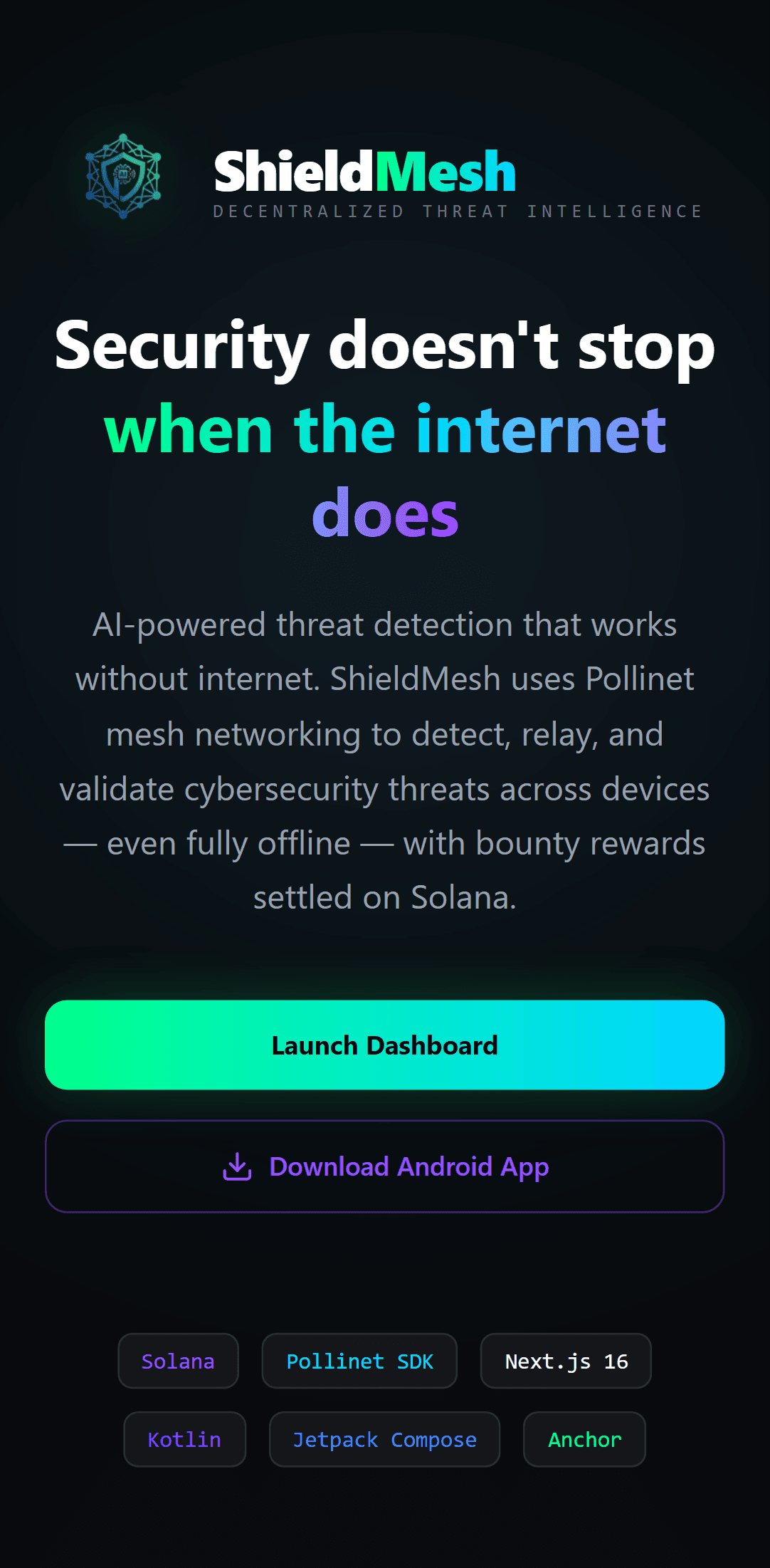
Offline-first decentralized threat intelligence. Every phone becomes a security node: on-device AI detects phishing and scams, alerts relay device-to-device over a BLE/Wi-Fi Direct mesh, and verified threats settle on Solana with bounties for reporters. Hackathon winner ($800).
Tornike Kalandadze — software engineer & technical lead, client delivery since 2019 · Tbilisi (GMT+4)
Android build
ShieldMesh.apk
Problem
Every cloud security tool dies at the exact moment it's needed most — during internet shutdowns, disasters, and attacks on connectivity. Billions live with unreliable internet; phishing doesn't pause when the network does. There was no offline security layer.
Approach
On-device pattern-matching detection (no cloud, no latency), Pollinet mesh relay over BLE/Wi-Fi Direct for device-to-device alerts, consensus verification by nearby peers, and batch settlement on Solana by the first device that regains connectivity — a native Kotlin/Jetpack Compose app with Room offline storage, an Anchor program in Rust (staking, bounties, immutable threat log), and a Next.js 16 dashboard with wallet integration.
Impact
Championship winner ($800 prize). Working end to end — downloadable APK, devnet-deployed program, and a dashboard anyone can open. Built solo.
Through every lens
01 · Full-stack
One system across three runtimes — Rust/Anchor on-chain, Kotlin on-device, Next.js on the web — sharing a single threat-lifecycle state model.
02 · Mobile
Native Kotlin with Jetpack Compose and Room: the phone is the security node, fully functional offline — detection, storage, and mesh relay with no network at all.
03 · Frontend
A Next.js 16 dashboard with Phantom wallet integration and a responsive landing that serves the APK directly — no app store dependency.
04 · Automation
The offline queue is the pipeline: threats queue locally, relay through the mesh, and the first reconnected peer settles the entire backlog on-chain in one batch.
05 · Security
The domain itself — on-device phishing and scam detection, peer consensus to kill false positives, and an immutable, auditable threat log anyone can verify.
06 · AI
Detection that works with the internet off: an on-device pattern-matching engine — zero cloud dependency, zero per-scan cost, and nothing to exfiltrate.
Built with
Kotlin · Jetpack Compose · Rust · Anchor · Solana · Next.js · TypeScript · Tailwind CSS · Room · Pollinet SDK
Notes
How it works
ShieldMesh turns every device into a security node. An on-device detection engine scans URLs, messages, and payloads with zero cloud dependency — it keeps working when the internet doesn't. Detected threats relay device-to-device over a Pollinet mesh (Bluetooth LE / Wi-Fi Direct), nearby peers verify them by consensus, and the first device that regains connectivity settles the whole backlog on Solana in one batch.
The on-chain program
An Anchor program (Rust) owns the threat lifecycle end to end: initialize_pool, stake, unstake, report_threat, verify_threat, and claim_bounty. Every verified threat — hash, severity, AI confidence score, reporter, validators — is recorded permanently on-chain, a community-owned threat intelligence database anyone can audit. Bounties scale with severity, from 0.01 SOL (low) to 0.25 SOL (critical), paid from a community-staked pool.
Three runtimes, one system
- Android — native Kotlin with Jetpack Compose; Room database holds the offline threat queue, a sync manager watches connectivity and settles it on reconnect.
- Web — a Next.js 16 dashboard (landing, dashboard, scan, threats, bounties, mesh) with Phantom wallet integration; serves the APK directly, no app store dependency.
- Chain — the Anchor program on Solana devnet, with StakingPool, ThreatAccount, and StakerAccount as the on-chain state.
Recognition
Winner of the VibeCoding From 0 hackathon (Superteam Georgia × CyreneAI × Solana) — built solo, working end to end: downloadable APK, devnet-deployed program, and a live dashboard.